
What will I learn in the Ultimate Homeowner’s Guide to HELOCs?
Our HELOC guide answers the questions homeowners actually ask before they apply. You can expect to find the following information
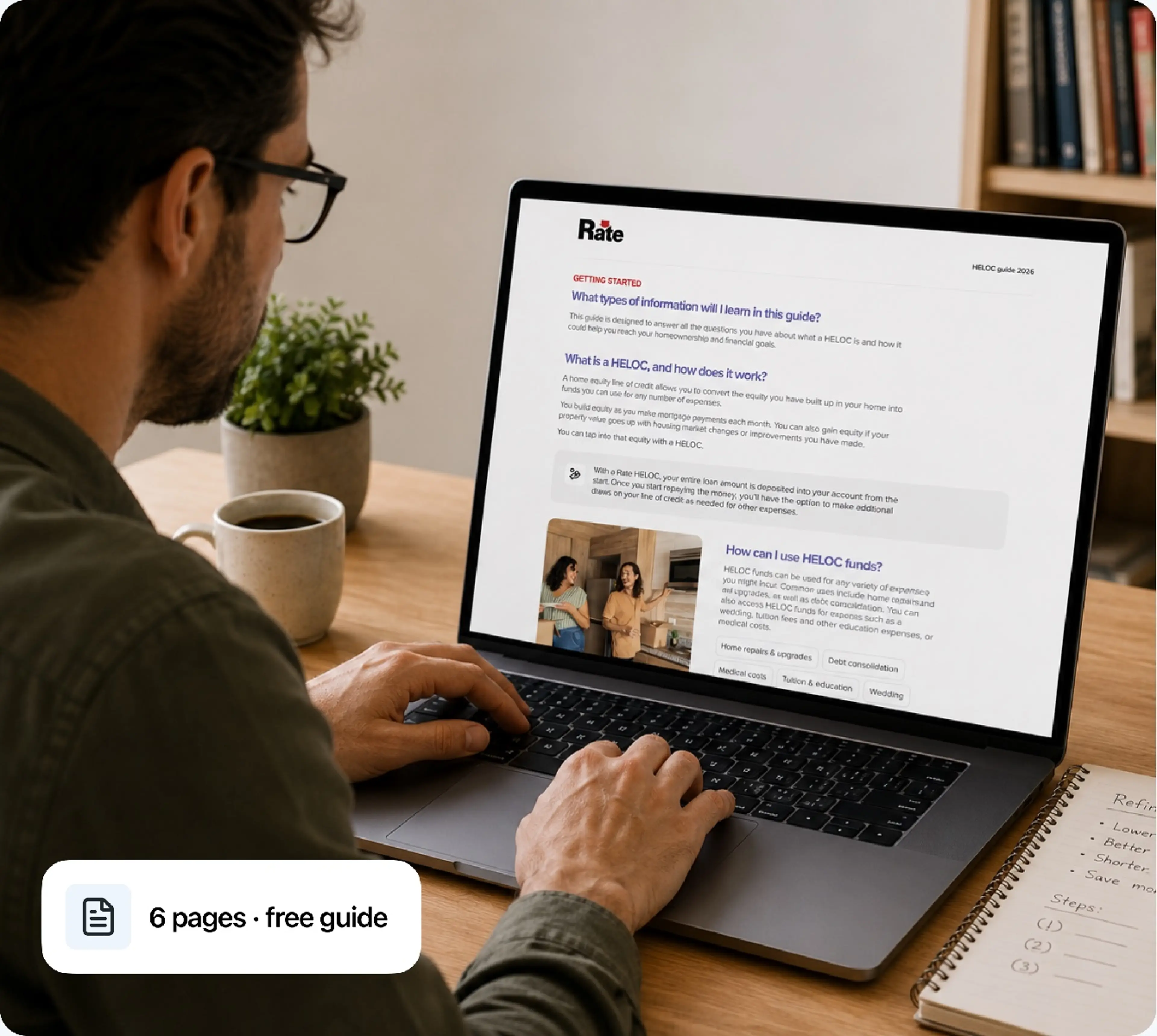

What is a HELOC, and how does it work?
How the equity you’ve built becomes funds you can draw on.

How can I use HELOC funds?
Home repairs and upgrades, debt consolidation, medical costs, tuition and more.

What are the steps to get started?
Six steps, from checking your equity to completing the application.

Which types of HELOC are available?
Compare fixed and variable rates, and what each one means for you.

What do I need for a HELOC application?
The full document checklist, so nothing slows you down later.
Am I ready to apply for a HELOC?
Before you start, it helps to know where you stand. The guide walks through the preparation lenders expect:
How to calculate the equity you’ve built in your home
Why most lenders look for 15% to 20% equity
How your credit score affects the rate you’re offered
What a debt-to-income ratio is, and the number lenders look for
Which documents to gather before you apply
What to expect from the appraisal


Fixed or variable which is right for you?
HELOCs generally come with variable interest rates. Rate offers both, and the difference matters more than most people expect.
The guide explains each one plainly so you can decide before you’re on the phone with anyone.
How a fixed rate gives you stability as you repay
Why a variable rate might start lower, and how it adjusts
What each choice means over the life of the line
Download the free guide
12 pages of tips, advice, and key questions answered everything a first-time buyer needs, in one place.

Rate home equity line of credit (HELOC) is an open-end product where the full loan amount (minus the origination fee) will be 100% drawn at the time of origination. The initial amount funded at origination will be based on a fixed rate; however, this product contains an additional draw feature. As the borrower repays the balance on the line, the borrower may make additional draws during the draw period. If the borrower elects to make an additional draw, the interest rate for that draw will be set as of the date of the draw and will be based on an Index, which is the Prime Rate published in the Wall Street Journal for the calendar month preceding the date of the additional draw, plus a fixed margin. Accordingly, the fixed rate for any additional draw may be higher than the fixed rate for the initial draw. This product is currently not offered in the states of New York, Kentucky, West Virginia, Delaware and Maryland. The HELOC requires you to pledge your home as collateral, and you could lose your home if you fail to repay. Property insurance is required as a condition of the loan and flood insurance may be required if your property is located in a flood zone. Borrowers must meet minimum lender requirements in order to be eligible for financing. Available for primary, second homes and investment properties only. Dependent on minimum credit score and debt-to-income requirements. Occupancy status, lien position and credit score are all factors to determine your rate and max available loan amount. Not all applicants will be approved. Applicants subject to credit and underwriting approval. Contact Rate for more information and to discuss your individual circumstances. Restrictions apply.
During Rate’s Digital HELOC process, the borrower and/or Rate may need to communicate or facilitate the origination and closing of the borrower’s HELOC using non-digital methods, including but not limited to telephone or letter. There may be instances, due to borrower preference, applicable law, or other reasons, in which HELOC closing must occur in person. Additionally, Rate makes no representations and cannot guarantee that borrower’s HELOC will be serviced by a servicer that maintains an entirely digital process.
Applications may be completed in five minutes but may fluctuate. Five business day funding timeline assumes closing the loan with our remote online notary. Funding timelines may be longer for loans secured by properties located in counties that do not permit recording of e-signatures or that otherwise require an in-person closing. In addition, funding timelines may be longer if we cannot readily verify that your property is in at least average condition with no adverse external factors with a property condition report and may need to order a desktop appraisal to confirm the value of your property. Texas borrowers will have a 12-day cooling period prior to closing on their home equity loan which will begin after the borrower has both filed a loan application and received consumer disclosures.