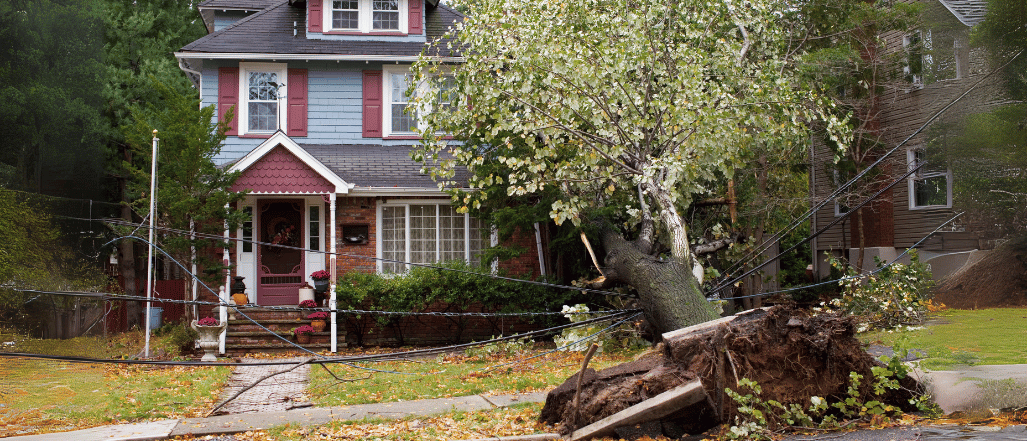
Homeowners have insurance to protect themselves against financial losses in cases where their home is damaged by a covered peril. This protection is so important that if you have a mortgage, your lender likely requires you to carry homeowners insurance on your property.
If your home is damaged beyond your ability to live in it, such as a total loss after it is hit by a tornado, you almost certainly will file a claim. This is exactly what home insurance is designed to do—get your home back to livable condition.
But, what should a homeowner do when the issue is not so clear-cut? For example, what happens if you have a small kitchen fire that causes $10,000 in damage, and you have a $3,000 deductible? Should you file a claim, or should you cover the additional cost out of pocket to protect against a premium increase?
There are pros and cons to filing a home insurance claim, and it is important that homeowners think these points through as they decide whether to file a claim for damages.
See how you could save on insurance
Pros
You can repair your home without taking on additional debt – One of the most important considerations homeowners face when determining whether to file a claim is how much it will cost to fix the damage. If you can afford to pay out of pocket for repairs, it’s probably better not to file a claim. However, if the damage is extensive it makes sense to file.
The work needed can be done right – There are some home repairs that are DIY, and there are others that absolutely should only be tackled by professionals. Homeowners who DIY big tasks to save money or avoid filing a claim could make things a lot worse—and subsequent damage caused or made worse by an amateur repair job is unlikely to be covered by insurance. If your home is damaged by a named peril, talk to your agent.
You’ll get your home back to its previous condition – When your home is damaged by a covered peril, there may be damage that isn’t visible. Damage to a roof can lead to leaks, which can cause extensive water damage and mold growth inside the walls. The claims process is thorough, and professionals will look to repair and replace what they need to in order to get your home back to its prior condition.
Cons
You will probably see your rates go up – Filing a claim isn’t guaranteed to raise your rates, but it might. There are a lot of calculations that go into determining insurance premiums, and filing claims is one of them. If it’s your first claim and a necessary but unlikely-to-occur-again type of repair, it’s possible that your premium will stay the same. Expensive and repeat claims are almost certain to raise your rates.
It can take a while to settle – The claims process can be important to restore your home, but it is rarely a quick one. This can be particularly true if the covered event was a natural disaster that led to a high number of damaged homes in an area. Complex, expensive claims take time.
You may risk a non-renewal – Particularly in some areas of the country, repeat disasters such as wildfires have led to some insurers making the determination that the risks of covering homes in the area are too great. A non-renewal is also a risk if you’ve made multiple claims in a relatively short amount of time, as it indicates that either you or the area you live in represents a higher risk than the company wants to insure.
What else should homeowners know about filing a claim?
Know what is in your policy – Understanding how your deductible works and if you have any policy limits that could impact your claim are two important considerations. The amount of your deductible will be subtracted from the claim, so understanding what that amount is can be key to making the determination if it makes sense for you to file a claim.
For example, if your home is insured for $350,000 with a deductible of 2% of the insured value, you are responsible for the first $7,000 of the claim. If the amount of repairs needed is $10,000 in this scenario, you’ll receive $3,000 as a claims settlement. Is $3,000 worth risking an increase in your premium?
Policy limits are another factor to consider. Your homeowners insurance covers personal property from theft, but certain categories of belongings are subject to individual loss limits. Jewelry, cash, and electronics typically have dollar limits within your homeowners policy. If someone breaks into your home and steals a jewelry box with a $20,000 diamond ring in it and your policy has a loss limit on jewelry of $1,500—your claim is limited to that $1,500.
Similarly, take time to understand ACV vs. RCV – Actual cash value (ACV) and replacement cost value (RCV) are important terms to understand, because they will affect the amount of your claim settlement, which may have an impact on your decision as to whether it makes sense for you to file a claim. ACV is essentially the depreciated cost of your possessions, while RCV is the cost it would take to replace your property at today’s prices.
Let’s say a storm causes a tree branch to break a window, and rainwater soaks the couch by the window, ruining the fabric. If your policy values that couch at its ACV, it probably isn’t going to be worth much. In this scenario, the value of the couch is low enough that you might not even reach your deductible, so there is no point in filing a claim.
Another reason it is important to understand your coverage is that some insurers offer policies that offer RCV for a set time period, after which the policy automatically converts to an ACV policy. This makes the timing of your loss a factor in how much you can expect to receive as a claims settlement. If your homeowners insurance policy converts from an RCV to an ACV policy after 10 years, damage nine years into your policy would be settled at a higher rate than the same damage if it occurs eleven years into your policy.
Know what caused the damage – Damage that is a result of neglecting regular maintenance will not be covered by your insurance. If you have missing roof shingles or cracked siding and water from a storm gets in and causes leaks, the insurance adjuster will likely put the damage down as a result of poor maintenance and your claim will be denied.
There’s a lot to think about when you file an insurance claim, and it’s important that homeowners are aware of the downsides. Insurance is designed to protect you from catastrophic losses, not to fix smaller issues.
If you want to learn more about what is in your policy and how that can affect your claims process, talk to the experts at Rate Insurance. With access to hundreds of insurers, they can help you understand how your policy would shape the claims process. And, if you decide your current coverage isn’t the right fit, they can help you find a policy that meets your needs.
Make sure your home is protected
Disclaimer:
All information provided in this publication is for informational and educational purposes only, and in no way is any of the content contained herein to be construed as financial, investment, or legal advice or instruction. Rate Insurance does not guarantee the quality, accuracy, completeness or timelines of the information in this publication. While efforts are made to verify the information provided, the information should not be assumed to be error free. Some information in the publication may have been provided by third parties and has not necessarily been verified by Rate Insurance. Rate Insurance, its affiliates and subsidiaries do not assume any liability for the information contained herein, be it direct, indirect, consequential, special, or exemplary, or other damages whatsoever and howsoever caused, arising out of or in connection with the use of this publication or in reliance on the information, including any personal or pecuniary loss, whether the action is in contract, tort (including negligence) or other tortious action.