Homeowners insurance policies are designed to help you return your home to a safe, livable condition after a covered peril. The benefit of having homeowners insurance is that expensive repairs can be completed without draining your savings or pushing you into debt.
There are some important things to consider if you’ve had a pipe burst in your home. The amount of damage, how much cleanup is needed, and how much repairs will cost over and above your insurance deductible are all factors to think about, along with the chance that your premiums may increase following a claim.
Make sure your home is protected
Steps to take if a pipe bursts in your home
The first thing to do is shut off the water. Find the valve leading to the pipe and shut it off. The best thing to do is identify where the valves are before there’s an issue. Seeing water cascading from a pipe in the middle of your utility room doesn’t lead to calm thoughts, so knowing exactly how to shut off your pipes is a good idea. Depending on where the leaky pipe is located, you may need to shut off the water to the whole house.
Open up the taps in other areas, such as the kitchen and bathrooms. This will drain the water in the pipes, reducing any pressure that might build up in the system.
Call a plumber. A professional plumber will help to identify the problem and will be able to safely turn off electricity if that is required. Remember that water conducts electricity, so standing water from a burst pipe can be a very dangerous situation if there are live outlets.
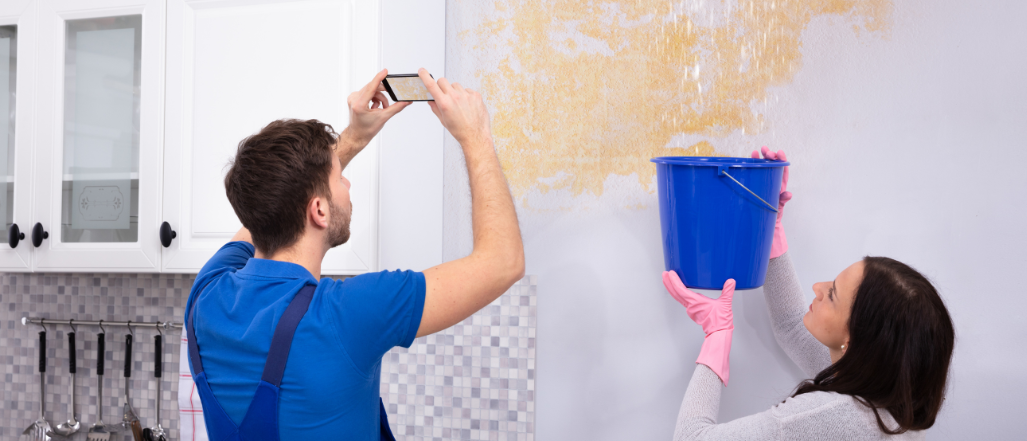
Take pictures if it is safe to do so. This will help to record the scale of the damage and what might need to be replaced. Saturated drywall, for example, can harbor mold and mildew if it is not dried properly or replaced if the damage is extensive.
Contact your insurance company. If the water damage is substantial, you will want to contact your insurer. They may have recommendations on water removal experts in your area, which may be particularly helpful if you end up submitting a claim.
Remove the excess water. Once it has been determined that it is safe to do so, you will want to get rid of the water. If you caught the burst pipe soon after it happened, this may be a quick task. However, if there’s a lot of water, you may need to call a professional water removal service.
Check the surrounding areas. Water can seep into all sorts of crevices and saturate porous surfaces, causing damage that you don’t see immediately. This is particularly true if the pipe that burst is in the attic or upper floors of your house, as gravity will pull water down. You could end up with water pooling in unexpected places or within walls, which has the potential to cause significant damage over time if it is not cleaned up and remediated quickly.
What causes a pipe to burst?
This question is very important to answer if you are considering filing an insurance claim. Why? Because of a critical phrase in your homeowners insurance policy. Take a close look at the wording in your homeowners insurance, and you will probably see the phrase “sudden and accidental” in there somewhere (or similar wording).
This means that in order for your claim of water damage to qualify, the burst pipe must have been caused by something sudden and accidental, and not due to the result of ignoring a problem or deferred maintenance.
There are many reasons a pipe in a home might burst. Freezing temperatures in the winter are a common cause of burst pipes. When temperatures drop so much that a home’s heating system cannot keep up, especially in homes with poor insulation or older pipes, burst pipes are a possibility.
A sudden increase in water pressure can also cause pipes to burst. Faulty pressure regulators or a change in demand can cause the water pressure to spike suddenly. Freezing temperatures and water pressure changes are likely to qualify as “sudden and accidental” reasons, and therefore may qualify as a claim.
There are other reasons a pipe could burst that would not qualify as a claim. Corrosion happens over time, and checking the pipes in your home to make certain they are in good condition is a responsibility of the homeowner. Clogged pipes can also cause pressure buildups or drips as water saturates the clog.
Tree root incursion into pipes can cause problems as well. While tree roots will typically puncture pipes outside of your home, leading to a possible drop in water pressure, the nature of water pipe damage means that there could be issues that eventually appear inside your home. Damage from leaking, punctured, clogged, and corroded pipes are a sign of neglected maintenance, and are unlikely to be covered.
Similarly, a sudden shift in your home’s pipes can cause them to burst. This can happen in an earthquake, and damage from earthquakes or sinkholes is typically excluded from standard homeowners insurance coverage.
What can you do to prevent pipes from bursting?
Being proactive about maintenance and insulation will go a long way toward preventing leaks and bursts. As a homeowner, it is your responsibility to keep all of your home’s systems in good shape.
Investigate anything that seems atypical. If there’s a weird smell coming from anywhere near a faucet or drain, track it down—it could be a sign of a clog. If your water pressure seems to have dropped, figure out what might be causing it to do so.
Add appropriate insulation to pipes, paying close attention to any that are located on exterior walls. Address drips as soon as possible, and regularly inspect fittings for signs of decay or corrosion.
Make sure that you know what your homeowners insurance policy will cover and what it won’t. Homeowners are frequently caught off guard when they learn that extensive, expensive water damage and remediation won’t be covered by their homeowners policy because it is the result of a lack of maintenance.
If you want to know more about what is covered and how to protect your home, contact the experts at Rate Insurance. With access to a wide range of insurance options for homeowners, they can help you find the right coverage at the right price for your budget.
See how you could save on insurance
Disclaimer:
All information provided in this publication is for informational and educational purposes only, and in no way is any of the content contained herein to be construed as financial, investment, or legal advice or instruction. Rate Insurance does not guarantee the quality, accuracy, completeness or timelines of the information in this publication. While efforts are made to verify the information provided, the information should not be assumed to be error free. Some information in the publication may have been provided by third parties and has not necessarily been verified by Rate Insurance. Rate Insurance, its affiliates and subsidiaries do not assume any liability for the information contained herein, be it direct, indirect, consequential, special, or exemplary, or other damages whatsoever and howsoever caused, arising out of or in connection with the use of this publication or in reliance on the information, including any personal or pecuniary loss, whether the action is in contract, tort (including negligence) or other tortious action.